
Beaver County Parole Versus Probation
Parole is conditional release from confinement while part of a sentence remains to be served under supervision. Probation is a court-ordered period of community supervision that may be imposed instead of jail or after a term of confinement. Beaver County Adult Probation and Parole supervises county court cases. The Pennsylvania Parole Board makes parole decisions for most state sentences, while PA DOC provides field supervision after state release. Those roles cannot be merged. A PA DOC result should not be expected for every person on county probation or county parole.
The sentence and commitment identify the right path. A county court order may assign regular probation, county parole, or restrictive probation. Beaver County describes restrictive probation as a midpoint between incarceration and traditional supervision, with tools such as electronic monitoring, house arrest, or day reporting for eligible cases. State parole means the person continues serving a state sentence in the community. Neither status is an unconditional discharge.
| Supervision type | Who controls it | Best verification source |
|---|---|---|
| County probation | Beaver County Court and Adult Probation | Criminal docket, sentencing order, county office |
| County parole | Beaver County Court and Adult Probation | Parole order, docket, county office |
| State parole | Pennsylvania Parole Board and PA DOC | PA DOC supervised-person locator and Board Action |
| Restrictive probation | Beaver County Court and Adult Probation | Court order and county program office |
- Discharge
- The formal end of the sentence or supervision term.
- Board Action
- The written Pennsylvania Parole Board decision issued in an individual state case.
- Recommitment
- A return to custody ordered through the parole violation process.
- Absconder
- A person alleged to have stopped required contact with a supervising authority.
Verify Beaver County Post-Release Supervision
Begin with the docket, not a broad name result. The Pennsylvania UJS Case Search can show Beaver County sentencing, parole, revocation, and later modification entries. Match the court, docket number, participant details, and date of birth when available. A closed case label does not, by itself, prove that a supervision term ended. Sealed, expunged, and limited-access cases may also be absent from public search.
- Find the Beaver County criminal docket and read the latest sentence, parole, or probation order.
- Decide whether the order is county supervision or a commitment to Pennsylvania state custody.
- For a county case, contact Beaver County Adult Probation and give the docket number.
- For state parole, search the PA DOC Department Supervised Individual Locator by number when possible.
- Compare the listed district, permanent location, release date, and last update with the Board Action.
- Ask the originating office for a formal record when the public data is absent or disputed.
The PA DOC locator is limited to people currently within DOC custody or field supervision. Full discharge can remove someone from both public population views. A person whose only sentence was in Beaver County Jail may never appear there. For a named person released from county custody, the broader Beaver County released-inmate search path shows how to reconcile the jail movement entry, docket, and PA SAVIN event.
Note: A locator result helps identify present supervision, but the signed order or agency record remains stronger evidence of legal status.
Beaver County Supervision Office Contacts
The county office handles Beaver County court supervision. State parolees receive a PA DOC district or suboffice assignment based on their locator record, so a nearby state office should never be assumed. Public staff may restrict personal plan details, but the correct office can confirm its jurisdiction and explain public procedures.
Beaver County Adult Probation
Beaver County Courthouse
810 Third Street
Beaver, PA 15009
Phone: 724-773-8600
Hours: Monday through Friday, 8:00 a.m. to 4:30 p.m.
Beaver Falls suboffice: 1030 Eighth Avenue, Beaver Falls, PA 15010
Phone: 724-770-2025
After hours Police Center: 724-775-0880
The official Adult Probation page is the source for current contacts and hours. Verify details before travel. Office staff and assignments can change, and a main line is safer than relying on a named officer from an old document.
The official contact page is shown below as a practical check on the Beaver County supervision route.
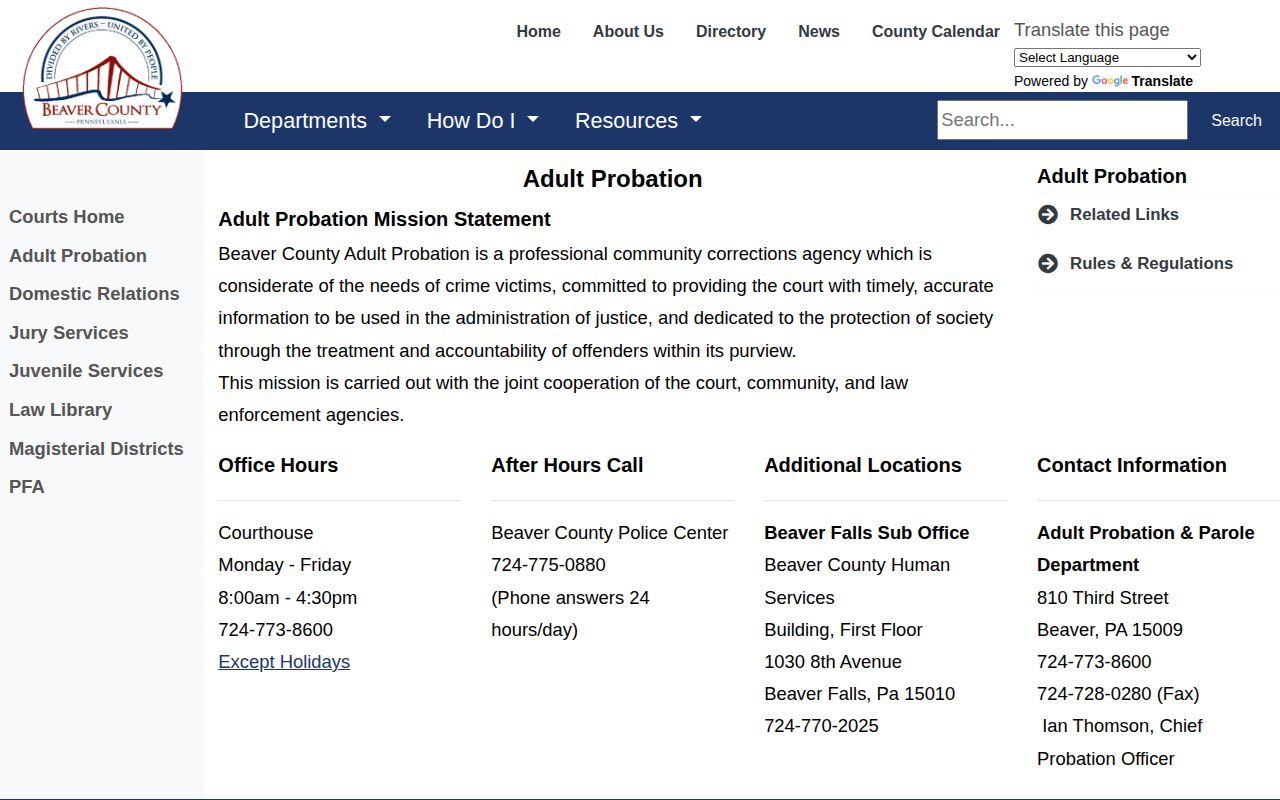
The capture helps identify the county office, but the latest official page should control if a telephone number, address, or schedule changes.
Beaver County State Parole Decisions
A Pennsylvania minimum date is the first ordinary parole eligibility point, not a promised release date. The Pennsylvania Parole Board process may involve an institutional interview and case review before eligibility. Section 6137 governs the Board's authority, while Section 6137.1 contains the separate Short Sentence Parole framework. Life and death sentences are not subject to ordinary Board parole.
No official public person-by-person future parole hearing calendar or public name search for individual Board Actions was found. The Board's public meeting calendar concerns agency meetings, not a named person's interview. The individual receives the Board Action. A lawful copy should be read on its own terms, and questions can go through the Parole Board contact route.
Decision words matter. A grant can remain subject to program completion, an approved home plan, or detainer resolution. A denial continues confinement. A deferral postpones a decision, and rescission withdraws a prior grant before release. None supplies the exact jail exit time.
The official Board meeting calendar illustrates the public schedule that is available.
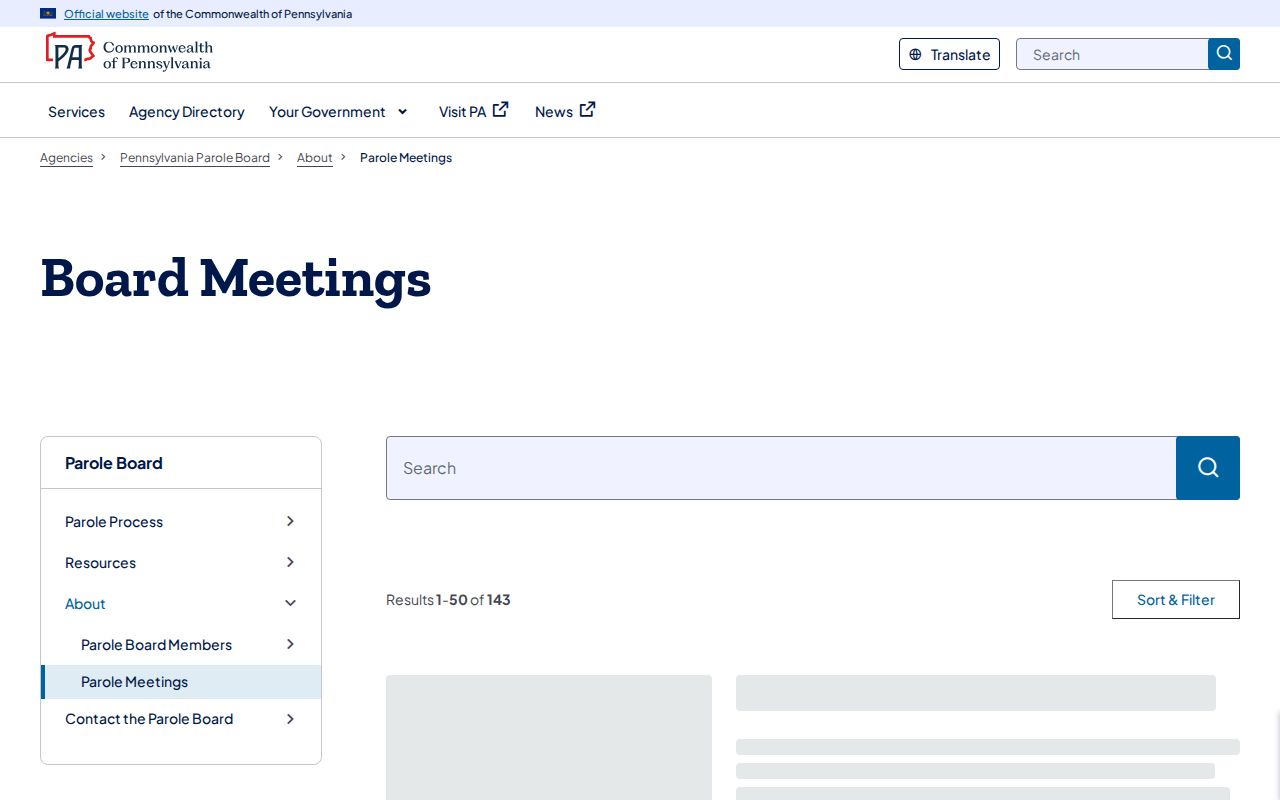
It must not be read as an individual parole hearing list. Case timing remains tied to the sentence, institution, and Board process.
Correct Beaver County Release Credits
Beaver County's Institutional Parole Representative and Population Control Officer, often called the IPR or PCO, joins the local record chain. The county says the role reviews inmate data, checks release eligibility, assists with credit computation, keeps county good-time records, coordinates court hearings, and works with the jail, Adult Probation, and Clerk of Courts. That internal review is unusually important because Beaver County publishes no public jail roster or release archive.
A person who disputes a release date or supervision start should identify every docket and the booking at issue. Ask the jail and Adult Probation to reconcile the commitment, credited time, good-time ledger, holds, and release authority with the Clerk's court record. A third-party roster cannot correct those source records. The official IPR/PCO description documents this county workflow.
A minimum-date change may alter parole eligibility without ending the maximum sentence. Likewise, a release entry may begin county parole or restrictive probation instead of complete discharge. The resulting record should name the event and agency rather than reduce it to “out.”
Beaver County Release Warrant Checks
A release from one Beaver County booking is not final resolution of every case. The Sheriff's Warrant Unit, based at the jail, processes Court of Common Pleas bench warrants. The official Sheriff's page reports that the unit cleared 1,958 warrants in 2018. That dated figure is useful only as historical operating context. It is not a current warrant count and does not describe one person's status.
Check the Beaver criminal docket for later warrant, bail, revocation, or commitment entries. A county bench warrant is distinct from a state parole warrant. State users can also consult the PA DOC absconder search. An absconder listing is an allegation of failed supervision contact, not proof of a new conviction. Do not approach a listed person. Follow the safety notice and contact the named authority.
The state search interface offers a distinct route for parole absconder information.
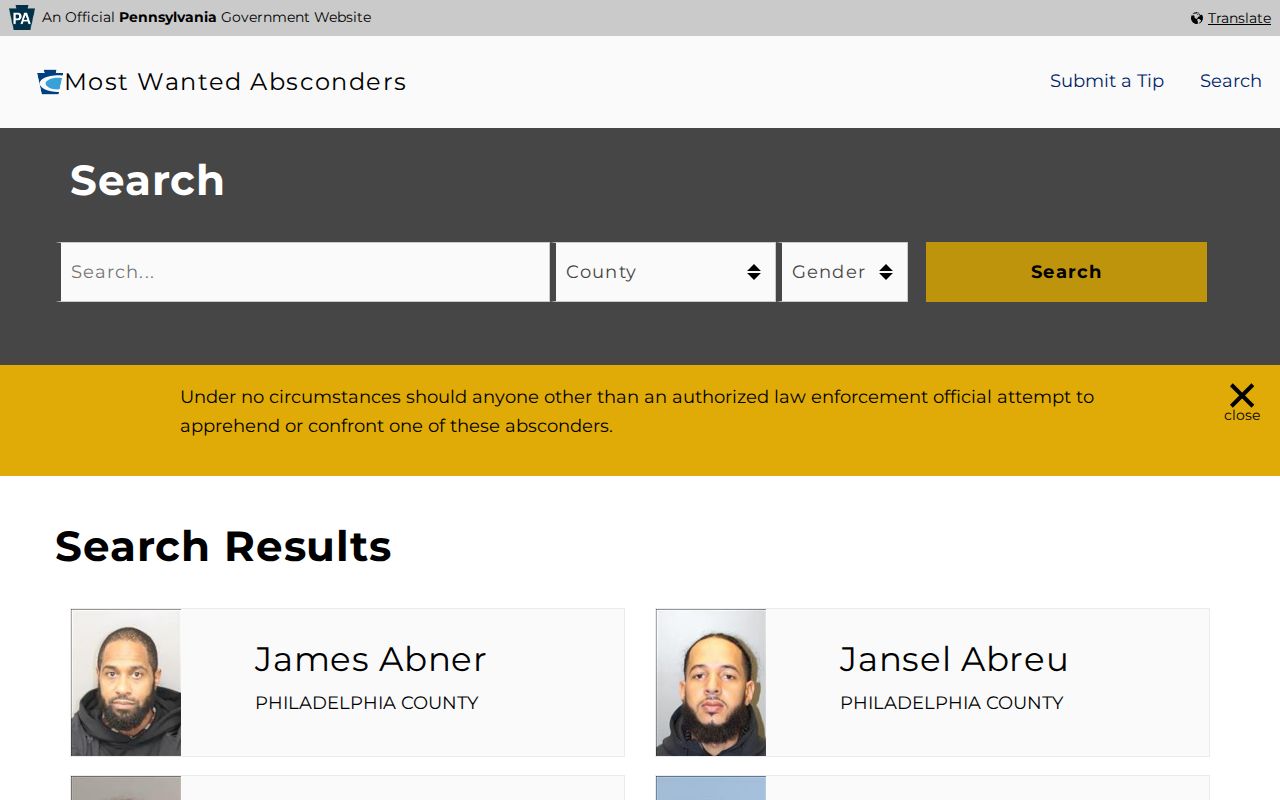
This interface concerns state parole. Beaver County bench warrants remain a county court and Sheriff's Office matter.
Beaver County Reentry Supervision Options
Local supervision can include more than office reporting. Beaver County's official material describes restrictive probation with house arrest, electronic monitoring, and day reporting for eligible cases. The county HealthChoices material also lists a Re-entry Liaison, while the state-posted county human-services plan describes efforts to continue jail reentry services after release. These sources support a route to ask about current programs, but they do not promise eligibility, placement, or a specific result.
Restrictive probation is still a sentence condition. Community placement means release from the jail setting, not unconditional discharge. A violation can return the person to Beaver County Jail. The supervising order and assigned office control, so program questions should begin with Adult Probation and the current court record.
When Beaver County Supervision Ends
Supervision ends through a formal event, not silence in a search result. County probation or parole may end under the sentencing order, a later court order, or completion recorded by Beaver County Adult Probation. State parole ordinarily continues until maximum expiration or another lawful discharge event, unless the sentence changes. A violation can instead lead to detention, recommitment, or a new supervision decision.
Request the final order or discharge record when the end date matters. For a county case, use the docket and the county office. For a state case, start with the supervised-person locator and Board Action, then request a PA DOC release or discharge record if the person no longer appears. Pennsylvania's Right-to-Know process can reach agency records, subject to exemptions, but a locator screenshot is not a certified record.
Absence has weak value. A restricted docket can vanish from public view, a fully discharged person can leave the DOC locator, and office staff may limit what they disclose by phone. The best conclusion names the authority, document, supervision type, and recorded end event.
Note: Discharge ends supervision; parole release begins community service of the remaining sentence and should not be described as the same event.